Throw a Paper Plane
Fold a real paper plane, then throw it out of the classroom window. Back to the game
How to play
First, fold. Pick one of five designs and watch a sheet of A4 printer paper fold itself crease by crease: the classic Dart, a wide Glider, the nose-heavy Nakamura Lock, a long-wing glider in the style of the record-setting Suzanne, and a stubby Stunt plane with its tail flaps bent up. Three of them unlock as you play.
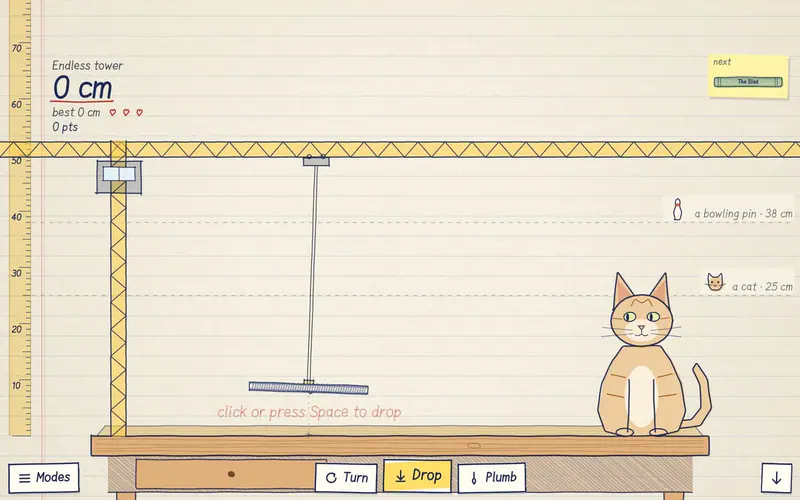
Then throw. You are standing at the back of a classroom on the top floor of a school, and the window is open. Press anywhere, drag back like a slingshot and let go. The further you pull, the harder you throw, from a gentle 3 m/s toss to a hard 16 m/s fling. Pencil dots show the first half second of the real flight. Get it out of the window and the plane can glide over the schoolyard, the street, the town, the park and the fields beyond, while a yellow tape measure along the ground counts the metres. On a keyboard, use the arrow keys to set the angle and speed and press Space to throw.
Before a throw you can trim the tail: bend its trailing edge up or down by a few millimetres with the slider. Little flags mark your last throws and your best, and the tall red flag out in the car park marks the real world record.
The physics: how a paper plane flies
Every plane is the same 5 gram sheet of 80 gsm paper, but each fold gives it a different wing. The game measures each finished shape: its wingspan, its wing area and its aspect ratio (span squared divided by area). The Dart has stubby, swept wings with an aspect ratio near 1; the long-wing glider is closer to 3.
Each moment of the flight is worked out from the same equations engineers use, in two dimensions, 240 times a second. Lift is ½ × air density (1.225 kg/m³) × speed² × wing area × the lift coefficient, which grows with the wing’s angle of attack. Drag has two parts: a fixed part from friction and shape, and induced drag, the price of making lift, which falls as the aspect ratio rises. That is why long thin wings glide flatter. Push the angle of attack too far and the wing stalls: lift collapses, drag shoots up and the paper flutters (you can hear it).
A paper plane also has a balance point. Because the centre of gravity sits ahead of the point where the lift acts, the plane is statically stable: if a gust tips the nose up, the lift pushes it back down. That is what makes a well-folded plane settle into a steady glide. Throw it too fast, though, and the extra lift makes it climb, slow down, dive and climb again in a long swoop called a phugoid. Throw it much too fast and it loops. Gentle throws usually go further than hard ones, which surprises most people.
Outside, the air moves. Wind and gusts change the plane’s airspeed. Asphalt, roads and car parks warm in the sun and send up thermals, columns of rising air; real glider pilots circle inside them to climb. A paper plane in this side-on world can’t turn, so the thermals here also draw the plane in a little, standing in for circling. Wind blowing against a building face is deflected upward too. Very close to the ground, within about half a wingspan, ground effect trims the induced drag. With a slow, floaty design and some luck, a thermal can carry you far past the indoor world record, which is a bit like cheating, and the game says so.
Tips for longer flights
- Throw gliders gently, around 4 to 7 m/s and nearly level. Save the hard throws for the Dart.
- If your plane climbs, stalls and dives, bend the tail down a millimetre. If it dives straight into the floor, bend it up.
- To get out of the window you need to stay above the sill, about 80 cm above the classroom floor, for five metres.
- Watch the shimmering lines over the schoolyard and car park: those are thermals. Slow planes ride them best.
- Check the windsock in the schoolyard. A tailwind adds metres; a headwind costs them.
Records and history
Paper planes have been folded since at least the 19th century, and the aerodynamicist Ludwig Prandtl folded one at a banquet in 1924. In 2012 former college quarterback Joe Ayoob threw John Collins’s design “Suzanne” 69.14 m (226 ft 10 in) in an aircraft hangar in California. That record has since been broken three times; most recently, on 28 December 2025 a plane thrown by Liu Liwen in Shanghai flew 98.43 m. The longest time aloft is 31.2 seconds, set in Kunshan, China, on 11 February 2026. Both records are indoor throws with a single sheet no bigger than A4.
Want more flying? Try ../land-the-rocket/ or ../fly-a-balloon/, or see how many folds it takes to reach the Moon in ../fold-it-to-the-moon/.
Questions people ask
- What is the best paper airplane design for distance?
- There is no single best. A dart copes with a hard throw, while wider, longer wings (a higher aspect ratio) lose less energy to induced drag and glide flatter, which is why long-wing gliders like Suzanne float so well.
- What is the paper airplane world record?
- The farthest flight is 98.43 m, by Liu Liwen in Shanghai on 28 December 2025. The longest time aloft is 31.2 seconds, set in Kunshan, China, on 11 February 2026.
- Why does my paper airplane loop or stall?
- It is flying at too high an angle of attack, usually because it was thrown too fast for its trim or its tail is bent up. Bend the trailing edge down slightly or throw more gently.
- Is the physics in this game real?
- The flight model uses the standard lift and drag equations with real air density, a 5 g mass and wing sizes measured from each fold, plus stall, pitch stability and ground effect. It is two-dimensional, so the plane cannot turn, and thermals pull it in slightly to stand in for circling.
- How much does a sheet of A4 paper weigh?
- About 5 grams for normal 80 gsm office paper, because an A4 sheet is one sixteenth of a square metre.
- Does it work on phones?
- Yes. Drag back with your finger and let go to throw. Tap the notes tab to scroll down to this page.